Three Consecutive Integers Have A Sum Of 57
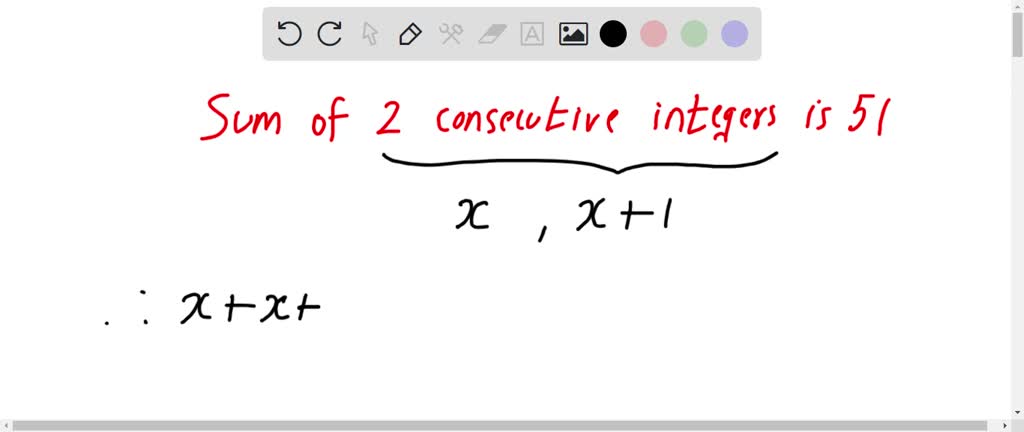
Imagine a little puzzle, a math riddle if you will. It's a neat little trick that pops up in the world of numbers. And this particular one is quite the charmer.
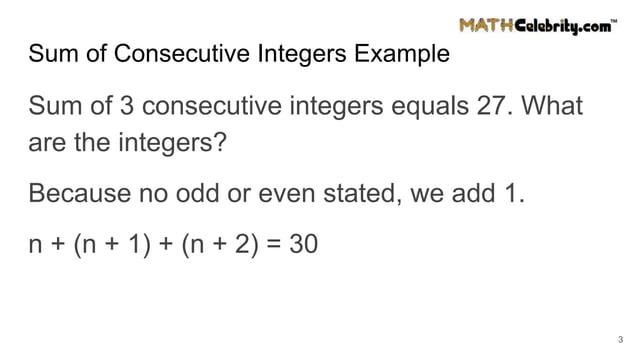
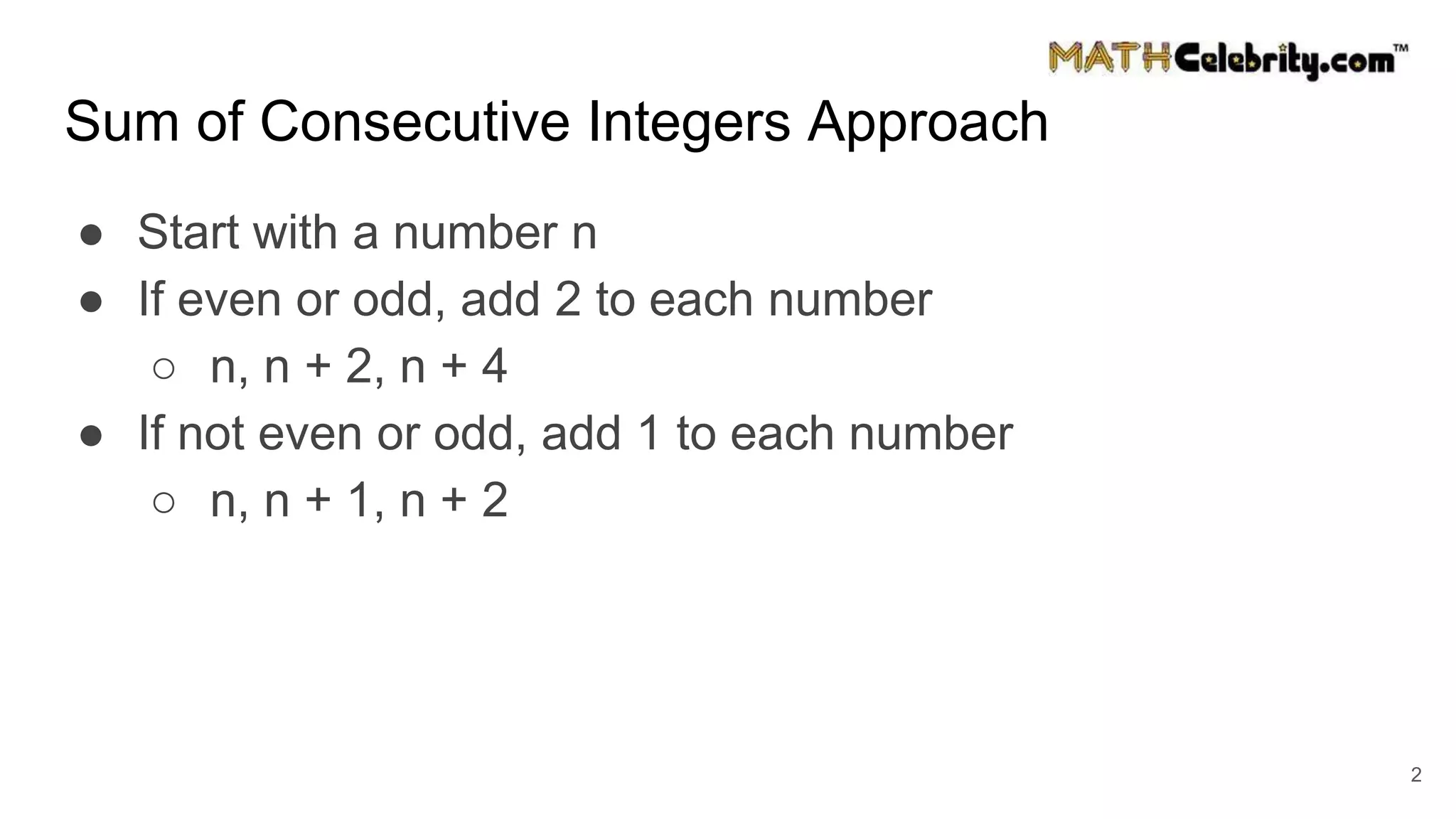
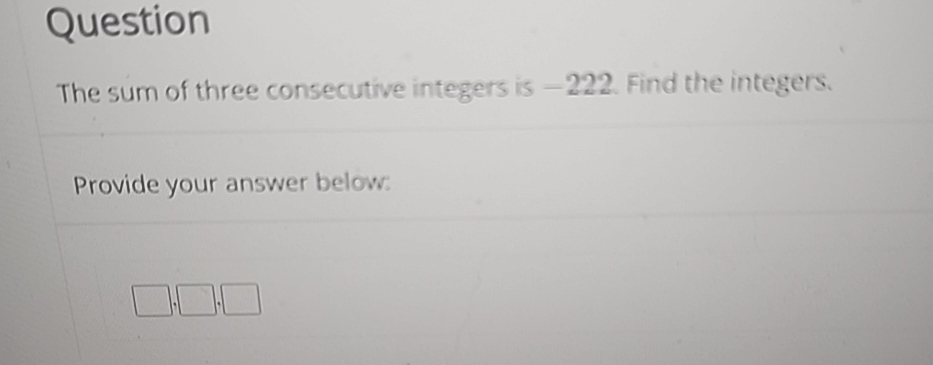
We're talking about three consecutive integers. Think of them as buddies, marching in line, one right after the other. Like 5, 6, and 7. Or maybe 10, 11, and 12. They're always just one step apart.
Now, here's the exciting part: when you add these three buddies together, their total is exactly 57. Isn't that neat? It’s like a secret handshake between these numbers.
Must Read
Why is this so entertaining? Well, it’s the beauty of finding a pattern. It's like uncovering a hidden message in the universe of numbers. A simple sum, yet it holds a special kind of magic.
It feels a bit like solving a mystery. You have a clue – the sum is 57. And you have a rule – the numbers must be consecutive. Putting those two pieces together is where the fun begins.
You can start guessing, of course! Try some numbers. What if we pick 10, 11, and 12? Their sum is 33. That's too low.
What about 20, 21, and 22? That sums up to 63. A bit too high this time! You can see how you're getting closer, though.
This is where the cleverness of math shines. You don't have to guess forever. There's a more direct way to find these numbers. It’s like having a secret decoder ring for number puzzles.
Let's think about the middle number. If you have three consecutive numbers, the middle one is kind of like the average. It’s the balanced point for all three.
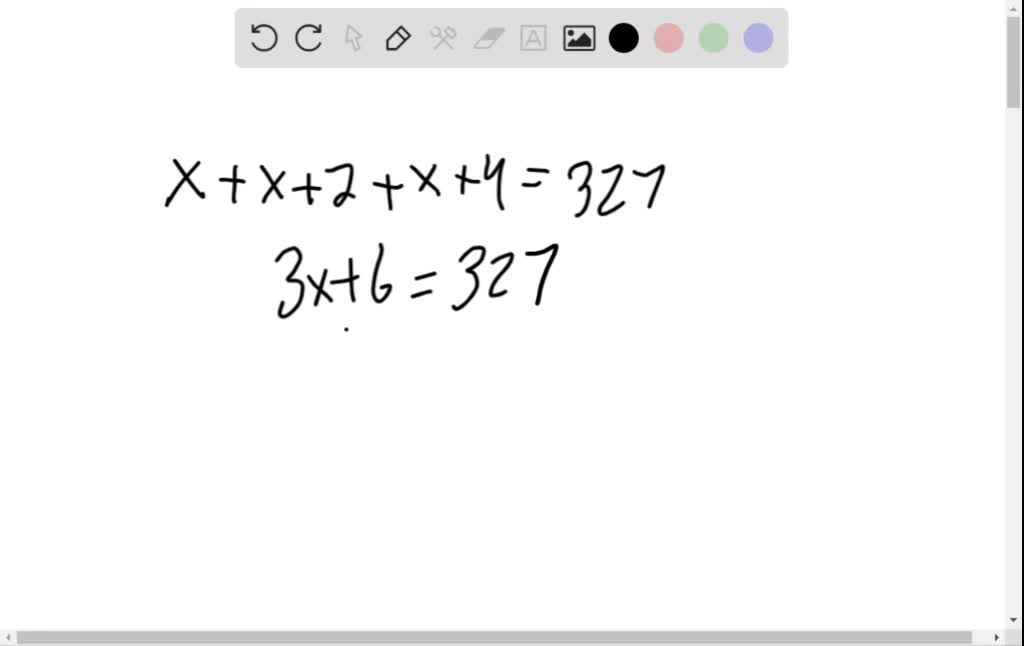
So, if the total sum is 57, and we have three numbers, what happens if we divide 57 by 3?
57 divided by 3 is 19.
Boom! There it is. That number, 19, is our middle buddy. It's the centermost of our three consecutive integers.
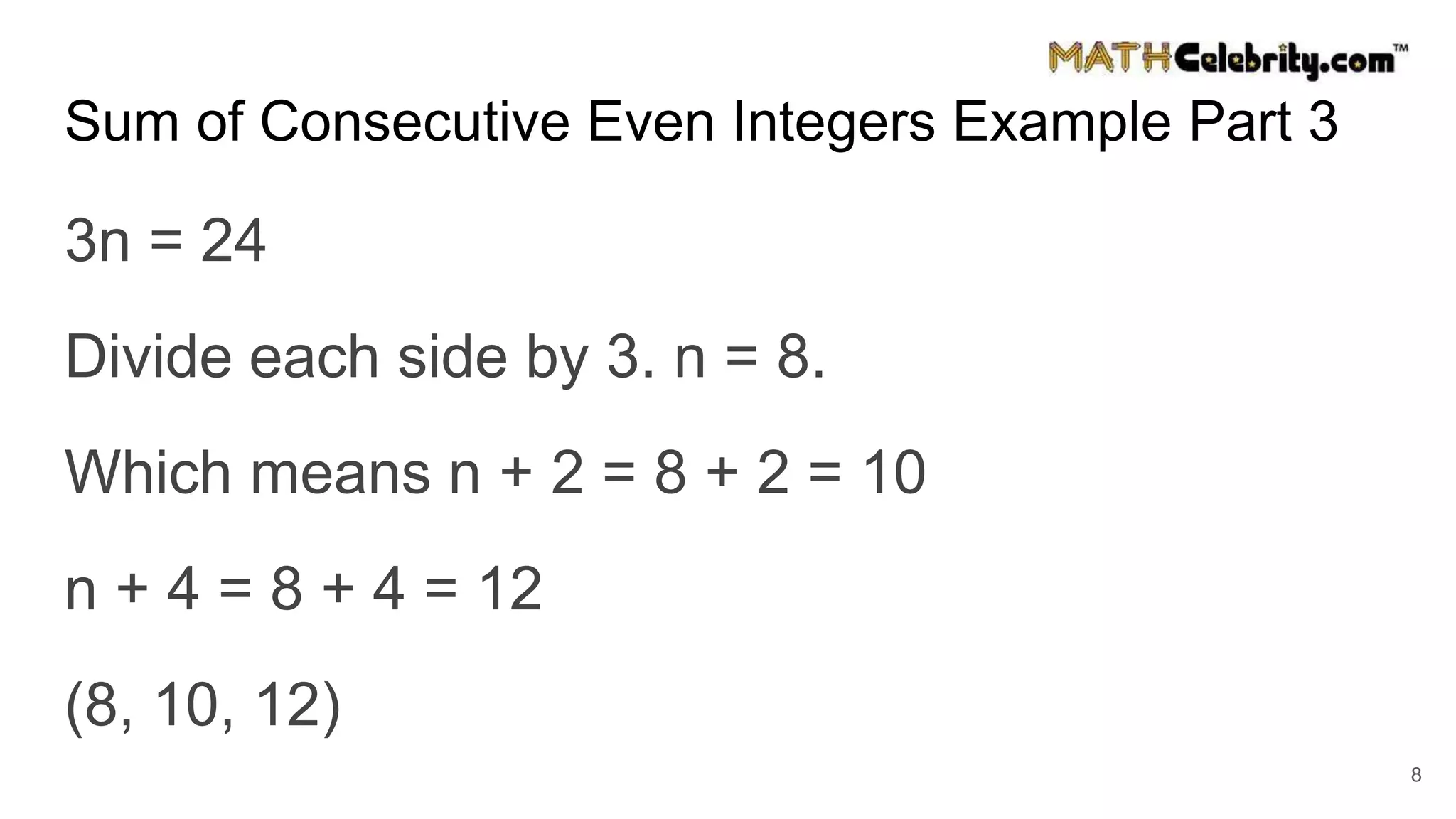
And if 19 is the middle one, what comes right before it? That would be 18. Easy peasy.
And what comes right after 19? That would be 20. So, our three consecutive integers are 18, 19, and 20.
Let’s check! 18 + 19 + 20. Does that equal 57?
18 + 19 = 37 37 + 20 = 57
Yes, it does! How cool is that? You've solved the puzzle.
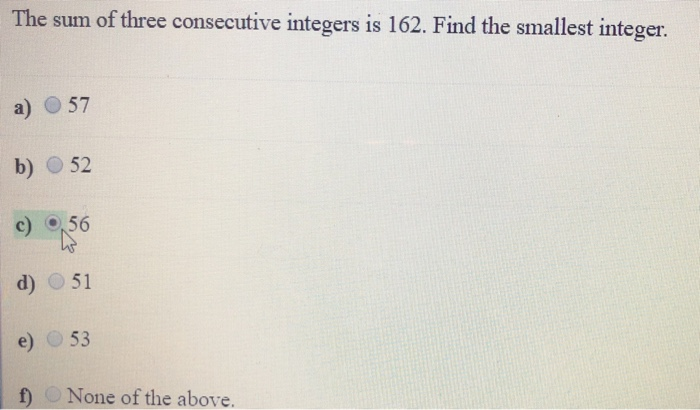
What makes this special? It’s the elegance of it. The simple truth that three consecutive integers adding up to 57 must be 18, 19, and 20. There's no other combination.
It’s a kind of certainty in the often-fuzzy world of possibilities. This riddle has a definitive, single answer. And you can find it with just a little bit of thinking.
This isn't some complex calculus problem. It's a friendly introduction to the idea that numbers can be predictable in beautiful ways. It shows that math can be more like a game than a chore.
The fact that 57 is divisible by 3 is key here. Not all sums will work so neatly for three consecutive integers. If the sum was, say, 58, you wouldn't find whole numbers that fit the bill.
This makes the number 57 a bit of a superstar in this little scenario. It’s a number that allows this neat trick to happen. It's like a lucky number for this particular puzzle.
Think about it: you can tell a friend, "Hey, guess what? Three consecutive numbers add up to 57!" And then, with a flourish, reveal the answer: 18, 19, and 20. It’s a little moment of mathematical triumph.
It’s also a great way to practice basic arithmetic. Addition and division. Skills we use all the time, but here they're applied to something a bit more intriguing.
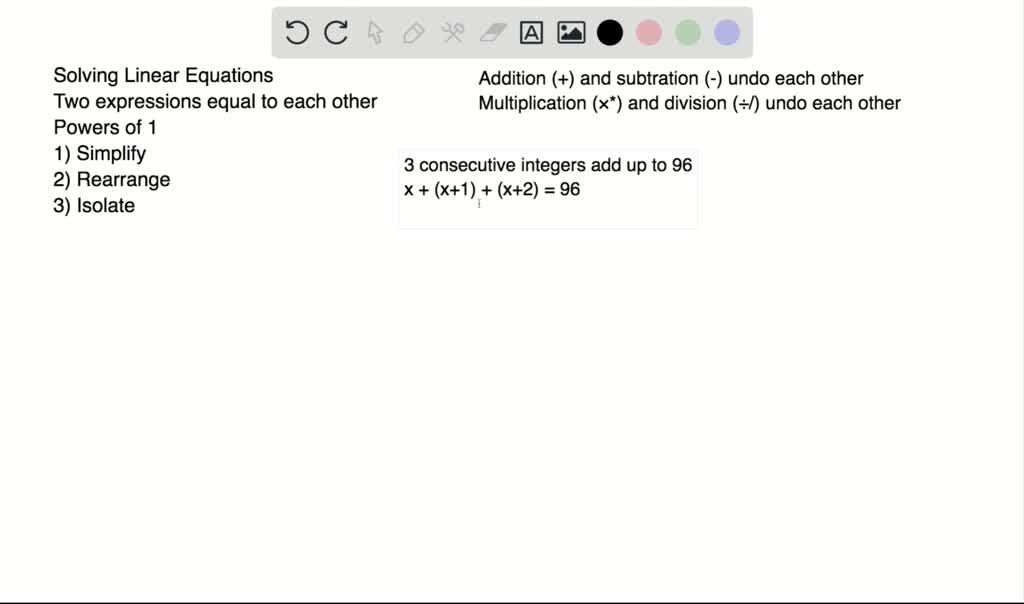
The language used in math problems can sometimes sound a bit stiff. But when you break it down, "three consecutive integers" just means three numbers in a row, like steps on a staircase. And "sum" is just fancy word for "total" or "what you get when you add them up."
So, the riddle is really saying: "What three numbers in a row, when you add them, give you 57?" And the answer is a perfect little trio.
What if you wanted to make your own riddle? You could pick any three consecutive integers, add them up, and then pose the question. For example, pick 50, 51, and 52. Their sum is 153. So, you could say, "Three consecutive integers have a sum of 153. What are they?" The answer would be 50, 51, 52.
This principle works for any set of three consecutive integers. It's a universal truth in the number world. The middle number will always be one-third of the total sum.
It’s this underlying rule, this mathematical law, that makes these puzzles so satisfying. It’s not random chance; it’s order and logic at play. And that can be incredibly comforting and exciting.
Sometimes, the simplest mathematical statements hold the most profound beauty. This is one of those times. It’s a tiny window into the elegant structure of numbers.
So next time you see a problem like "Three consecutive integers have a sum of 57," don't shy away. Embrace it! It’s an opportunity to play with numbers, to uncover a little secret.
It’s a delightful little brain teaser that requires just a touch of arithmetic and a dash of curiosity. And the reward? The sweet satisfaction of finding that perfect, consecutive trio. It's a small win, but a win nonetheless!
This kind of puzzle reminds us that math is all around us, in simple and often overlooked places. It’s not just for textbooks; it’s in the fabric of everyday numbers. And sometimes, those numbers have a really fun story to tell.
So, go on, try to find another sum that works for three consecutive integers. Or try to figure out if a sum like 58 could work. You might be surprised at what you discover. The world of numbers is full of these little delightful surprises, just waiting to be found.
The story of 18, 19, and 20 summing to 57 is a testament to the order and harmony found within arithmetic. It’s a simple example that can spark a greater appreciation for how numbers behave, and why. It’s a friendly invitation to explore a bit further.
It’s the kind of math that makes you smile. The kind that feels more like a game of discovery than a strict lesson. And that, in itself, is quite special.