What Is The Composition Of A Dna Fragment
Hey there, life enthusiasts! Ever stare at those cool science-y images of DNA and wonder what’s actually going on inside that iconic double helix? You know, the one that looks like a twisted ladder or maybe a super-fancy staircase? Well, let’s ditch the intimidating textbooks and chat about it like we’re grabbing a latte. Today, we’re unraveling the mystery of a DNA fragment, and trust me, it’s less brain surgery and more like piecing together your favorite playlist. Easy peasy.
Think of DNA as the ultimate instruction manual for pretty much every living thing on Earth. From the fluffiest cat to the mightiest oak tree, and yes, even you and me, we’ve all got this incredible blueprint. And a DNA fragment? That’s just a tiny, tiny piece of that grand manual. It’s like a single sentence, a crucial paragraph, or even just a word in that enormous book.
The Building Blocks: More Than Just Fancy Letters
So, what makes up this super-important fragment? Imagine building with LEGOs, but way, way smaller and with a very specific set of pieces. A DNA fragment is primarily made of nucleotides. Sounds a bit technical, right? But let's break it down. Each nucleotide is like a mini-unit, and when they link up, they form that long, winding DNA strand. Think of them as the beads on a string, and the string itself is the DNA molecule.
Must Read
Each nucleotide has three main components, like a little three-part combo meal: a phosphate group, a sugar molecule (specifically, deoxyribose sugar, but we can just call it ‘sugar’ for simplicity), and a nitrogenous base. This last part, the nitrogenous base, is where the real magic happens, because these are the "letters" of our DNA alphabet.
The Alphabet of Life: A, T, C, and G
These nitrogenous bases are the stars of the show. There are only four of them, and they’re usually represented by their first letters: A, T, C, and G. That’s it! Just four letters, but the order they appear in creates an infinite number of possibilities. It’s like how the 26 letters of the English alphabet can create Shakespeare, a gripping thriller, or your grocery list. Pretty amazing, huh?
So, you’ve got your A, T, C, and G. But they don’t just hang out randomly. They have best friends! Adenine (A) always pairs up with Thymine (T), and Cytosine (C) always pairs up with Guanine (G). This is called complementary base pairing, and it’s super important. It’s like a constant, reliable duo, always together.
Imagine A and T as a stylish pair of sneakers, and C and G as a comfy pair of loafers. They just naturally go together. This pairing is what allows DNA to form its famous double helix structure. You see, one strand has the sequence A-T-T-G-C-A, and its partner strand will have T-A-A-C-G-T. They're like mirror images, but in a very specific, coded way.

The Double Helix: A Twisted Love Story
Now, let’s talk about that iconic shape. The double helix isn’t just for show; it’s a brilliant design for protecting the genetic information. Think of it as a ladder that’s been twisted. The sides of the ladder are made up of alternating sugar and phosphate groups (remember those?). This is called the sugar-phosphate backbone, and it’s super strong and stable. It’s the frame of our DNA ladder, providing structure and support.
The rungs of the ladder? Those are formed by the paired nitrogenous bases – A with T, and C with G. These bases are held together by relatively weak chemical bonds, called hydrogen bonds. While they're weak individually, there are millions of them in a single DNA molecule, making the whole structure surprisingly sturdy.
It’s this specific arrangement – the sugar-phosphate backbone on the outside and the base pairs on the inside – that gives DNA its characteristic twisted shape. It’s efficient, it’s elegant, and it’s been working for billions of years. Nature really knows how to design!
What Makes a "Fragment"?
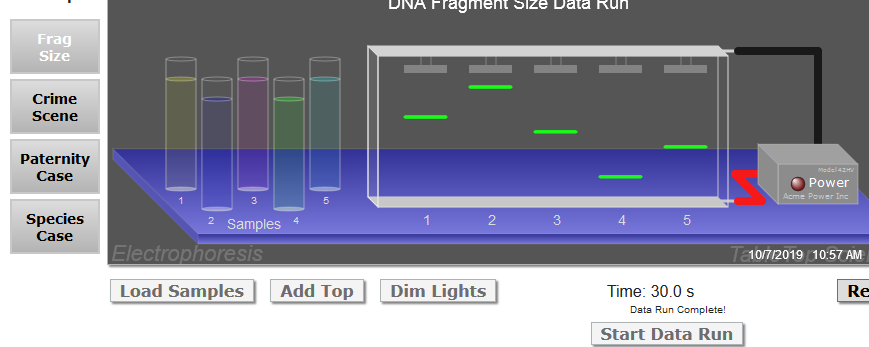
So, what’s the deal with a "fragment"? It simply means a piece of a larger DNA molecule. DNA in our cells is incredibly long, coiled up tightly to fit inside our tiny nucleus. When scientists or even your own cells need to work with DNA, they might isolate or generate shorter pieces. These are your DNA fragments.
Think of it like cutting a long ribbon into smaller, more manageable lengths. Each of those shorter lengths is a fragment. In biology labs, techniques like PCR (polymerase chain reaction) are used to amplify and isolate specific DNA fragments. This is super useful for everything from solving crimes (hello, CSI!) to understanding diseases and developing new medicines.
Fun Fact: The complete human genome, if stretched out, would be about 6 feet long! Imagine trying to fit that into something smaller than a speck of dust. That’s why coiling and fragmenting are so important!
The "Backbone" and the "Rungs" Revisited
Let's reiterate the key players in our DNA fragment. We've got:
- The Sugar-Phosphate Backbone: This forms the sturdy, structural sides of our DNA ladder. It’s made of repeating units of deoxyribose sugar and phosphate groups.
- The Nitrogenous Bases (A, T, C, G): These are the "letters" that form the rungs of the ladder. Their sequence is what carries the genetic code.
- Hydrogen Bonds: These are the "glue" that holds the base pairs together.
A DNA fragment, then, is essentially a short sequence of these nucleotides, arranged in that characteristic double helix structure. It still has the sugar-phosphate backbone on the outside and the complementary base pairs on the inside. It’s a miniature version of the whole grand design.

Why Should We Care About DNA Fragments?
Okay, so we know what they are, but why is this stuff actually cool or relevant? Well, understanding DNA fragments is at the heart of so many modern marvels. Think about:
- Forensics: That DNA evidence at a crime scene? It’s often tiny fragments of DNA that are analyzed to identify individuals. It's like finding a single, unique puzzle piece that can tell a whole story.
- Medical Diagnostics: Doctors can use DNA fragments to detect genetic mutations associated with diseases like cancer or inherited conditions. This allows for earlier diagnosis and more targeted treatments.
- Gene Therapy: This revolutionary field aims to treat genetic disorders by introducing or modifying DNA fragments in a patient's cells. It's like editing a typo in the instruction manual to fix a problem.
- Ancestry Testing: Companies that help you trace your roots? They analyze specific DNA fragments to see how your genetic makeup compares to different populations and historical groups. It’s a personal journey through millennia.
- Agriculture: Scientists use DNA fragments to improve crops, making them more resistant to pests or more nutritious. It’s all about optimizing the blueprint for better yields.
Cultural Connection: Remember the excitement around the first cloned animal, Dolly the sheep? That was all made possible by understanding and manipulating DNA, including its fragments. It felt like science fiction becoming reality!
The "Reading" of DNA: It's All About Sequence
The real power of a DNA fragment lies in its sequence – the specific order of those A, T, C, and G bases. This sequence is like a code, dictating everything from your eye color to how your body processes certain foods. When we "read" a DNA fragment, we're simply determining that order of letters.
Think of it like reading a secret message. The longer the message and the more complex the cipher, the harder it is to crack. But with DNA, the "cipher" is remarkably consistent, and scientists have developed sophisticated tools to "read" these sequences accurately. It's a bit like having a universal translator for the language of life.
A Little Analogy: Your Favorite Song
Let’s try another analogy. Imagine your favorite song. It’s made up of individual notes (the bases) arranged in a specific order (the sequence). The rhythm and melody (the backbone and structure) hold it all together. If you took just a tiny snippet of that song – a few bars, perhaps – that would be your "DNA fragment" of the song. You can still recognize it, learn something from it, and understand its part in the larger piece.
Sometimes, a single changed "note" or a slight rearrangement of the "bars" can completely change the feel of the song, or in DNA's case, lead to a different trait or even a disease. It’s a testament to how much information is packed into these tiny structures.
The "Twist" in Everyday Life
It’s easy to think of DNA as something distant, confined to labs and textbooks. But the truth is, the principles behind DNA fragments are woven into the fabric of our daily lives, even if we don't see them directly. From the food we eat to the medicines we take, and even the historical stories we uncover, DNA is silently at play.
The next time you hear about a scientific breakthrough or a medical advancement, remember that it’s often built on understanding these fundamental building blocks – the nucleotides, their pairings, and the elegant structure of the DNA fragment. It’s a reminder of the intricate beauty of the natural world, operating at a level so small we can barely imagine it, yet dictating so much of what we are.
So, there you have it! A DNA fragment is just a small, structured piece of life's ultimate instruction manual, built from nucleotides with a sugar-phosphate backbone and bases that pair up in a precise way. It's the foundation for understanding ourselves and the world around us. Pretty neat, right? Now, go forth and appreciate the tiny, magnificent details of existence!